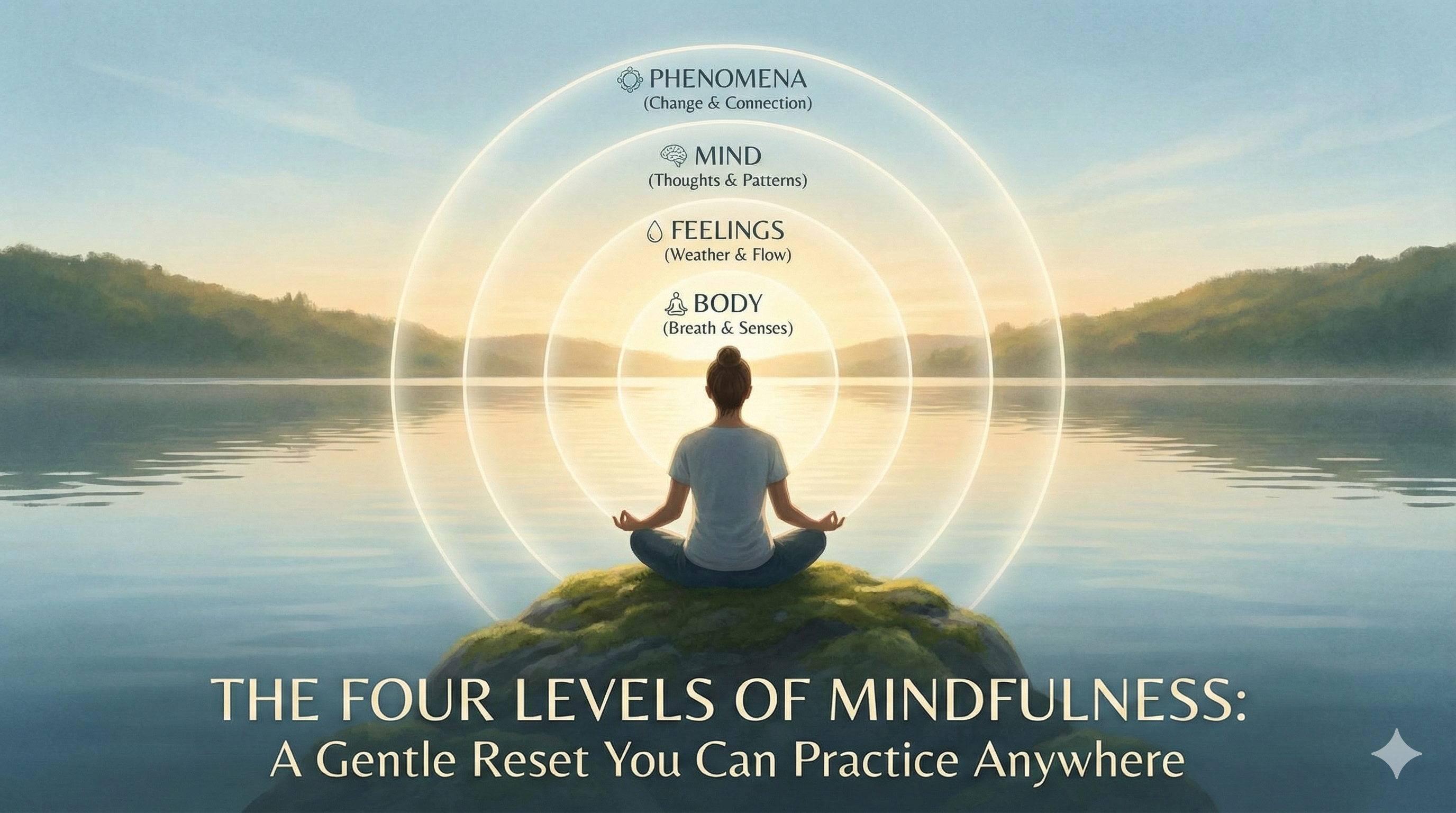
The Four Levels of Mindfulness: A Gentle Reset You Can Practice Anywhere
From a single breath to the bigger truths of change and interconnectedness—an invitation to come home to the present moment.
Do you ever practice a simple breathing exercise?
Does it do anything for you?
For me, it genuinely feels like a reset button. Not because it deletes what I’m feeling—but because it helps me remember something important:
Feelings will come, and feelings will go. They only get stronger when we cling to them.
Welcome to HelloKindness. Today, I want to share something that has helped me bring more steadiness, clarity, and compassion into everyday life: the four levels of mindfulness.
Think of these levels like gentle doorways. You don’t need to “master” anything. You can simply explore—one moment at a time.
And if anything here resonates, I’d love to hear from you in the comments.
The Four Levels of Mindfulness
- Mindfulness of the body
- Mindfulness of feelings
- Mindfulness of the mind (thoughts and mental activity)
- Mindfulness of phenomena (universal principles—how life works)
1) Mindfulness of the Body: Coming Back Through Your Senses
The first level of mindfulness is beautifully simple: use the body to stay present.
For many of us, the easiest doorway is the breath. You don’t need a perfect meditation setup, special music, or even a formal sit-down practice. You can simply notice:
- Air moving in through the nose
- Air moving out
- The rise and fall of the chest or belly
As you practice, something subtle happens. You start returning to now.
A 30-Second Reset (Try This Right Now)
- Take one slow breath in.
- Exhale gently.
- Notice: What’s here in this moment?
Do you sense a shift? Even a small one?
And it’s not only the breath. You can also return to the present through your senses—like sound.
Right now, for example, I can hear the hum of an air conditioner… and birds nearby. When you tune into what you can hear, you’re not trying to escape life—you’re stepping back into it.
Reflection: What helps you come back to the present—breath, sound, touch, movement, nature?
2) Mindfulness of Feelings: Letting Emotions Move Like Weather
The second level is mindfulness of feelings. I like to think of feelings in three simple categories:
- Pleasant
- Neutral
- Unpleasant
This can be challenging at first—especially when emotions are strong. When anxiety, frustration, or sadness shows up, it can feel like we become the emotion.
But mindfulness teaches something empowering:
A feeling is an experience—not an identity.
Instead of judging what we feel, we practice noticing it—just like we notice the breath.
An Everyday Example: Resentment Without the Spiral
I remember coming home after a long day of work—dinner, dishes, a full mind, tired body. The kids went off to do their thing, and I felt the familiar wave:
“Why do I have to do all of this?”
Resentment. Complaint. Unpleasantness.
But because of mindfulness practice, I could see it happening without turning it into a story I clung to. The feeling rose… and then it passed.
That’s the heart of it:
Feelings will come, and feelings will go.
They only grow stronger when we cling to them.
And Yes—We Can Be Mindful of Pleasant Feelings Too
Mindfulness isn’t only for difficult emotions. We can also bring awareness to joy.
I remember eating shabu-shabu with my family—nothing fancy, just good food and shared stories. I noticed a warm, simple happiness. Not “big excitement,” just a quiet joy.
Instead of grasping for it, I simply recognized it: “This is a joyful moment.”
Reflection: Is there a feeling you’ve been clinging to lately—pleasant or unpleasant? What changes if you treat it like a passing experience, not a permanent truth?
3) Mindfulness of the Mind: Thoughts Are Not Who You Are
The third level is mindfulness of the mind—our thought patterns, our stories, our mental habits.
With practice (especially meditation), we begin to see thoughts more clearly:
Thoughts are thoughts. They do not automatically represent who you are.
In modern life, it’s easy to get swept into the stream—information, worries, plans, opinions, “what ifs.” Without noticing, we start identifying with the noise. We believe our thoughts are our identity.
But mindfulness creates space. And in that space, we gain choice.
A Small Example: The Golf Course Mind
I remember playing golf in a friendly tournament. It was close, competitive, and when my friend lined up a putt, I noticed a thought arise:
“I hope he misses.”
That can feel uncomfortable to admit. But mindfulness isn’t about pretending we only have “nice” thoughts. It’s about noticing what’s there—without gripping it, without turning it into a verdict on who we are.
When we hold ourselves less tightly, thoughts can pass like clouds. They appear… and they move on.
At the same time, mindfulness helps us recognize patterns. If a harmful thought pattern becomes constant—and we remain unaware—then it starts shaping our personality and choices. Awareness is what keeps us honest, kind, and awake.
Reflection: Are there thoughts you’ve been taking as absolute truth? What happens if you label them gently as: “thinking”?
4) Mindfulness of Phenomena: Seeing How Life Works
The fourth level is mindfulness of phenomena—universal principles that teach us how things work.
Two themes stand out to me here:
- Change
- Interconnectedness
Phenomena #1: Change
Change is constant. We know this intellectually, but we forget it emotionally.
Even in one breath, there is change—oxygen in, carbon dioxide out. In walking, each step becomes the past as a new step becomes the present. In relationships, seasons shift. Words are said. Moments move.
The trouble often begins when something is good—health, love, stability, success—and we cling to it as if it must stay forever. It’s human to want that. But life moves.
Mindfulness of change doesn’t make us cold or detached. It helps us become more resilient—more prepared to meet change with steadiness instead of shock.
Phenomena #2: Interconnectedness
We are more interconnected than we realize.
Even just the fact that I can share these words, and you can receive them from wherever you are, is a reminder: our lives touch.
When we truly sense interconnectedness, something tender tends to grow:
- More compassion
- More empathy
- More care—for others and ourselves
We begin to remember we’re part of a whole. And that even small efforts—small kindnesses—can ripple further than we think.
A Gentle Closing: You Don’t Have to Practice Everything at Once
If the four levels feel like a lot, that’s okay. You don’t need to do it all.
You can start simply—right where you are:
- Return to the body with one mindful breath.
- Notice a feeling without judging it.
- Recognize a thought as “just thinking.”
- Remember change and interconnectedness when life feels heavy.
In my experience, the breath is often the doorway. When we learn to come back to the present through the body, we become more equipped to meet feelings, thoughts, and life itself with clarity and kindness.
If this post was helpful—deeply or even slightly—I’d love to hear from you.
Let’s Reflect Together
Which level of mindfulness are you feeling called to practice right now?
Body, feelings, mind, or phenomena?